

LONG VIDEO ALERT – but worth it!
So, this is what it takes to realize your dreams:
- COMMITMENT: Declare what you want, commit to your vision, walk past your obstacles… success begins in your mind and in your heart.
- TRUST: What if that which you are struggling with, is your opportunity for growth? What if it’s a gift wrapped in brown paper? Begin leaning into what is possible and when faced with a challenge ask yourself, why is this happening FOR me?
- SHARE: Your dream starts with you, but many times, like the story of this church, it lives on through others. What if you are simply called to start your movement/ organization/ company? Know when to let go, share.
As you sit around your Thanksgiving table today, if you are celebrating, be grateful for the opportunity to do the work that you do and trust that everything in your life right now, is exactly as it needs to be for you to fulfill your purpose.

Every year– as I work with the amazing speakers who take the stage– I’m blown away by the IDEAS for IMPACT these people bring into the world. Even the speakers– as they get to know each other during our group calls– are blown away by their colleagues. These are regular people– just like you and me– who have simply committed to their IDEAS and then worked hard to move them forward to benefit us all.
These are NOT just the speakers I coach for TEDxNewBedford. These are the clients I work with day in and day out. Whether they are working with me to clarify their message, write their talk or CLARIFY their strategy, these are IDEAPRENEURS through and through!
Are you one an IDEAPRENEUR as well?
YES, I AM! (click and let me know).
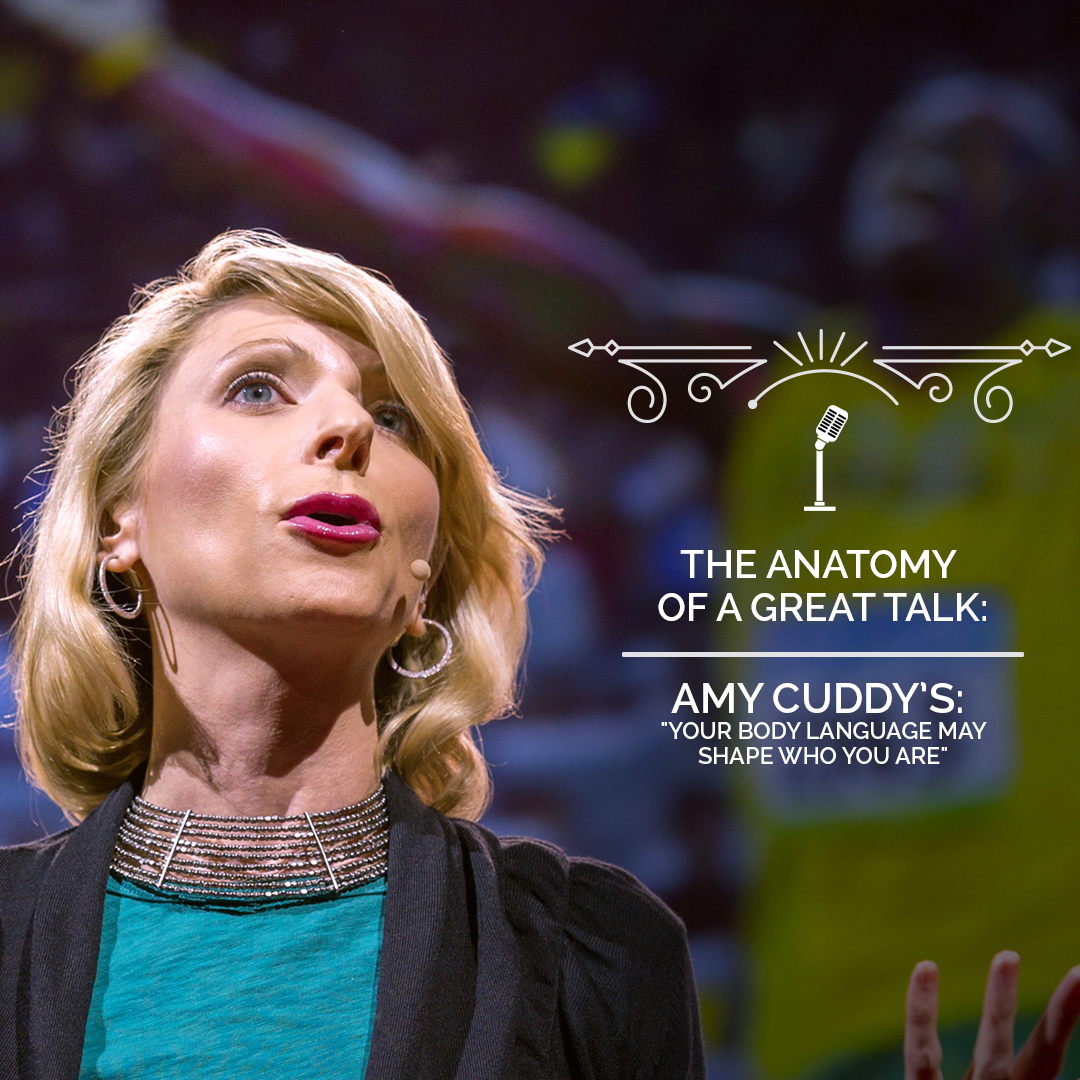
Continuing with our ANATOMY OF A GREAT TED TALK series— here’s Amy Cuddy’s: «Your Body Language May Shape Who You Are». There has been much debate about this talk and whether it is scientifically accurate or not is another conversation– but let’s take a look at the way she manages to deliver it.
Let’s break it down. What makes Amy Cuddy’s Talk– “Your Body Language May Shape Who You Are”– one of the top ten “most-watched” TED talks of all time?
To immediately engage the audience, she asks them to physically check in with their own bodies. She ends her opening paragraph with a promise to offer a life changing idea.
Minute 00:12- «So I want to start by offering you a free no-tech life hack, and all it requires of you is this: That you change your posture for two minutes….We’re going to come back to that in a few minutes, and I’m hoping that if you learn to tweak this a little bit, it could significantly change the way your life unfolds.”
INTRODUCE YOUR IDEA
She takes her time laying each brick for the framework of her idea. The first part is two questions which prompted the original query– and then she finally gets to the idea — the idea of «faking it until you make it».
MINUTE 06:58- «So my main collaborator Dana Carney, who’s at Berkeley, and I really wanted to know, can you fake it till you make it? Like, can you do this just for a little while and actually experience a behavioral outcome that makes you seem more powerful? So we know that our nonverbals govern how other people think and feel about us. There’s a lot of evidence. But our question really was, do our nonverbals govern how we think and feel about ourselves?”
INTRODUCE YOURSELF
MINUTE 03:38- «…I’m a social psychologist. I study prejudice, and I teach at a competitive business school, so it was inevitable that I would become interested in power dynamics. I became especially interested in nonverbal expressions of power and dominance.”
PRESENT THE EVIDENCE/DATA
Amy spends a lot of time talking about the experiments that led her to answer the questions at hand.
MINUTE 11:45- «Here’s what we find on testosterone. From their baseline when they come in, high-power people experience about a 20% increase, and low-power people experience about a 10% decrease. So again, two minutes, and you get these changes. Here’s what you get on cortisol. High-power people experience about a 25% decrease, and the low-power people experience about a 15% increase. So two minutes lead to these hormonal changes that configure your brain to basically be either assertive, confident and comfortable, or really stress-reactive, and feeling sort of shut down. And we’ve all had the feeling, right? So it seems that our nonverbals do govern how we think and feel about ourselves, so it’s not just others, but it’s also ourselves. Also, our bodies change our minds.»
REMIND THE AUDIENCE OF YOUR IDEA
MINUTE 19:15- «And so I want to say to you, don’t fake it till you make it. Fake it till you become it. Do it enough until you actually become it and internalize.”
REVEAL THE NEW REALITY
MINUTE 19:35- «The last thing I’m going to leave you with is this. Tiny tweaks can lead to big changes. So, this is two minutes. Two minutes, two minutes, two minutes. Before you go into the next stressful evaluative situation, for two minutes, try doing this, in the elevator, in a bathroom stall, at your desk behind closed doors. That’s what you want to do. Configure your brain to cope the best in that situation. Get your testosterone up. Get your cortisol down. Don’t leave that situation feeling like, oh, I didn’t show them who I am. Leave that situation feeling like, I really feel like I got to say who I am and show who I am.”
INVITE YOUR AUDIENCE TO TAKE ACTION
MINUTE 20:11- «So I want to ask you first, you know, both to try power posing, and also I want to ask you to share the science, because this is simple. I don’t have ego involved in this. (Laughter) Give it away. Share it with people, because the people who can use it the most are the ones with no resources and no technology and no status and no power. Give it to them because they can do it in private. They need their bodies, privacy and two minutes, and it can significantly change the outcomes of their life.”
If you are a TED talk fan, then you can’t miss TEDxNewBedford 2017 on 11/11. Early bird tickets end on 10/28 so don’t miss the opportunity to see these talks on a live stage.
In Clarity,

It’s Fall in the Northern Hemisphere!
With four children back in school this means: applying for college, (my oldest son is a senior), work, school dances, raking leaves, AND organizing a TEDx event for 1,200 people (coming up on November 11). And just to add to that list– it’s month #10 of a big crisis in my husband’s family.
It’s stressful…or busy, or crazy! Call it what you want. And sometimes it does not feel so good, so this talk really grabbed my attention.
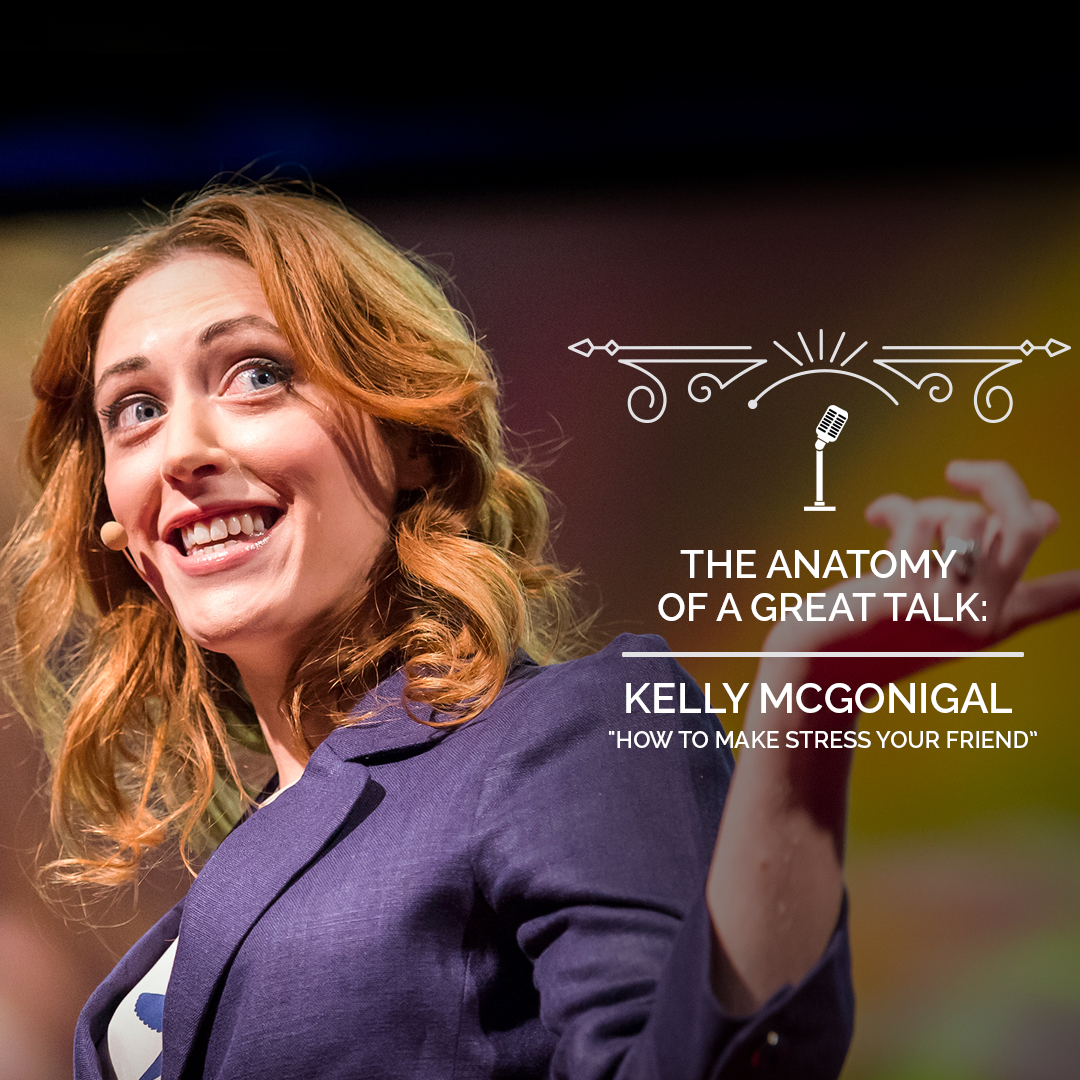
Kelly McGonigal brings a new perspective to stress in her talk «How To Make Stress Your Friend” which has been viewed by over 14 million people.

MAKE THE AUDIENCE CARE
As many great speakers do, Kelly starts off with an engaging series of questions, pulling the audience in from the get-go:
Minute 00:12: “I have a confession to make. But first, I want you to make a little confession to me. In the past year, I want you to just raise your hand if you’ve experienced relatively little stress. Anyone?”
INTRODUCE YOUR IDEA
Kelly introduces her idea after talking a bit about her process in formulating the idea itself. It works as a wonderful springboard into the rest of her talk:
Minute 03:08: «So this study got me wondering: Can changing how you think about stress make you healthier? And here the science says yes. When you change your mind about stress, you can change your body’s response to stress.»
INTRODUCE YOURSELF
Kelly uses her «self-introduction» as a means not only to introduce her background, but also to lay the foundation of her idea:
Minute 00:40: “But that is not my confession. My confession is this: I am a health psychologist, and my mission is to help people be happier and healthier. For years I’ve been telling people stress makes you sick. It increases the risk of everything from the common cold to cardiovascular disease. Basically, I’ve turned stress into the enemy. But I have changed my mind about stress, and today, I want to change yours.”
PRESENT THE EVIDENCE/DATA
Minute 01:20: “Let me start with the study that made me rethink my whole approach to stress. This study tracked 30,000 adults in the United States for eight years, and they started by asking people, «How much stress have you experienced in the last year?» They also asked, «Do you believe that stress is harmful for your health?» And then they used public death records to find out who died.”
( And she continues to cite multiple studies as she develops her topic.)
REMIND THE AUDIENCE OF YOUR IDEA
Minute 05:55; «Now, in a typical stress response, your heart rate goes up, and your blood vessels constrict like this. And this is one of the reasons that chronic stress is sometimes associated with cardiovascular disease. It’s not really healthy to be in this state all the time. But in the study, when participants viewed their stress response as helpful, their blood vessels stayed relaxed like this. Their heart was still pounding, but this is a much healthier cardiovascular profile. It actually looks a lot like what happens in moments of joy and courage. Over a lifetime of stressful experiences, this one biological change could be the difference between a stress-induced heart attack at age 50 and living well into your 90s. And this is really what the new science of stress reveals, that how you think about stress matters.»
REVEAL THE NEW REALITY
Minute 11:27: «Okay, so the bad news first: For every major stressful life experience, like financial difficulties or family crisis– that increased the risk of dying by 30 percent. But — and I hope you are expecting a «but» by now — but that wasn’t true for everyone. People who spent time caring for others showed absolutely no stress-related increase in dying. Zero. Caring created resilience.»
INVITE YOUR AUDIENCE TO TAKE ACTION
Minute 12:00: «And so we see once again that the harmful effects of stress on your health are not inevitable. How you think and how you act can transform your experience of stress. When you choose to view your stress response as helpful, you create the biology of courage. And when you choose to connect with others under stress, you can create resilience. Now I wouldn’t necessarily ask for more stressful experiences in my life, but this science has given me a whole new appreciation for stress. Stress gives us access to our hearts. The compassionate heart that finds joy and meaning in connecting with others, and yes, your pounding physical heart, working so hard to give you strength and energy. And when you choose to view stress in this way, you’re not just getting better at stress, you’re actually making a pretty profound statement. You’re saying that you can trust yourself to handle life’s challenges. And, you’re remembering that you don’t have to face them alone.»
In the meantime, I will embrace my stress, the racing of my heart, the sweaty palms, the rapid breathing– especially as I take the stage to lead our third TEDxNewBedford on November 11!
Have a great weekend,
 Last Saturday my husband and I were invited to my friend, neighbor, and Editor-in-Chief Linda’s party. She had designed a gathering especially to celebrate her daughter, Sarah’s «Going Steady» milestone.
As I sat at my table, I simply took some time to take in the ambiance.There were guests of all ages. (The couple sitting next to us have been friends with Linda and her family for over 40 years and had come from Pennsylvania for this party.) Her son’s band played. The guests of honor, Sarah and David, arrived at the Pavilion in a golf cart festooned with red balloons–David’s favorite color. They had a Mountain Dew toast. Linda made her signature chocolate chip cookies for dessert. It was a «true life» reunion.
I celebrate Linda and her family– not only for designing this event– but for understanding how to experience happiness!
The road has not always been easy. Her daughter was diagnosed with a life-threatening brain tumor 43 years ago–one which left her with multiple intellectual and physical challenges. But last Saturday they chose happiness and invited 100+ friends and family–the people who have been a part of this extraordinary journey and their circle of support through the years– to celebrate and celebrate we did!
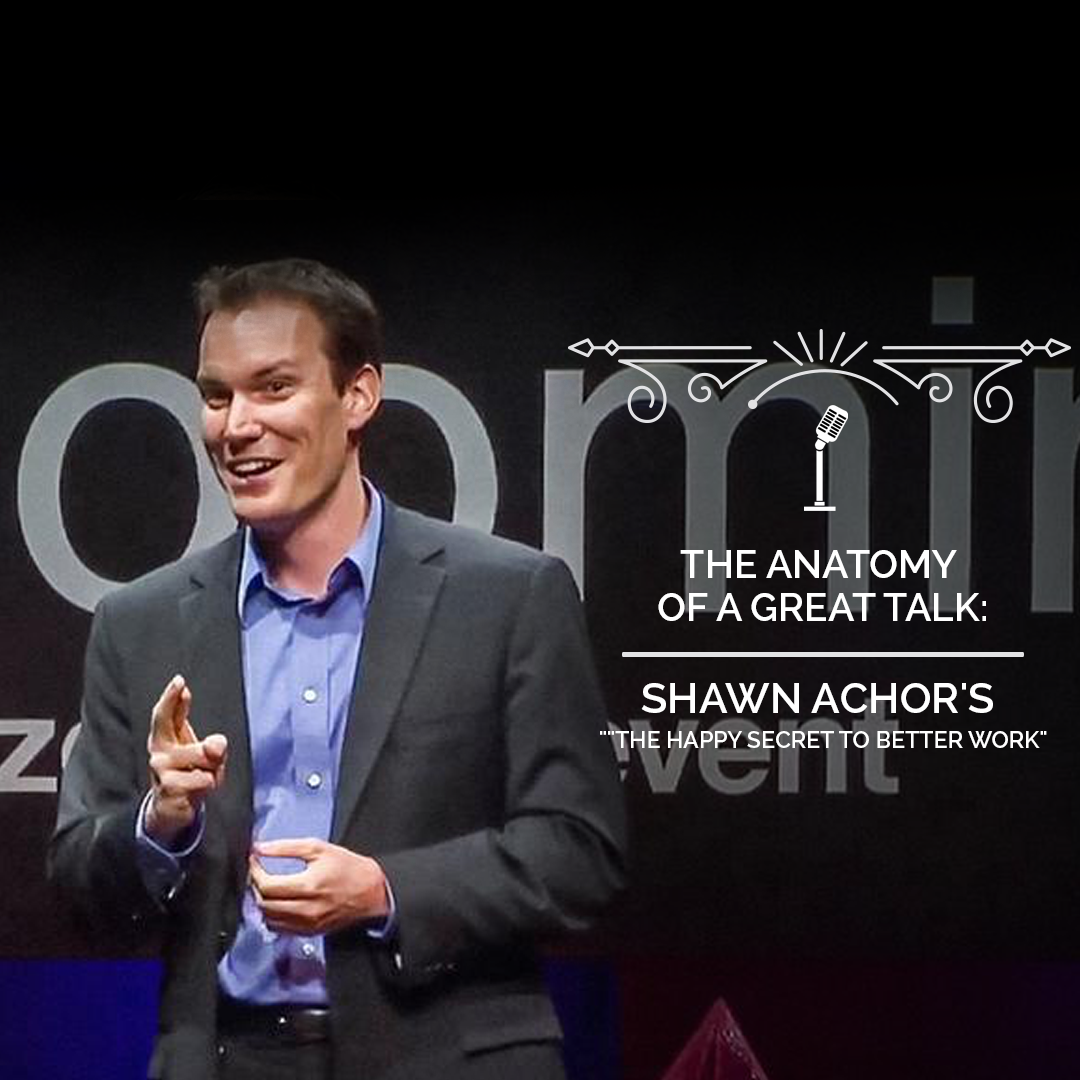
So, in honor of Linda, I want to talk about happiness and following my series THE ANATOMY OF A GREAT TALK we will explore Shawn Achor’s talk «The Happy Secret to Better Work»

MAKE THE AUDIENCE CARE
Shawn immediately engages his audience by starting with a personal story from his childhood:
Minute 00:39: “There are differing accounts of what actually happened that afternoon, but since my sister is not here with us today, let me tell you the true story…”
INTRODUCE YOUR IDEA
Minute 06:13: “We’re finding it’s not necessarily the reality that shapes us, but the lens through which your brain views the world that shapes your reality.”
INTRODUCE YOURSELF
Minute 06:27: “I applied to Harvard on a dare. I didn’t expect to get in, and my family had no money for college…”
Minute 03:03: “When I started talking about this research outside of academia, with companies and schools, the first thing they said to never do is to start with a graph.”
PRESENT THE EVIDENCE/DATA
Minutes 09:09: “I’ve traveled to 45 countries, working with schools and companies in the midst of an economic downturn. And I found that most companies and schools follow a formula for success, which is this: If I work harder, I’ll be more successful. And if I’m more successful, then I’ll be happier. That undergirds most of our parenting and managing styles, the way that we motivate our behavior.”
Minute 11:03: “We’ve found there are ways that you can train your brain to be able to become more positive. In just a two-minute span of time done for 21 days in a row, we can actually rewire your brain, allowing your brain to actually work more optimistically and more successfully…”
REMIND THE AUDIENCE OF YOUR IDEA
Minute 10:04: “But our brains work in the opposite order. If you can raise somebody’s level of positivity in the present, then their brain experiences what we now call a happiness advantage, which is your brain at positive performs significantly better than at negative, neutral or stressed. Your intelligence rises, your creativity rises, your energy levels rise.”
INVITE YOUR AUDIENCE TO TAKE ACTION
Minute 11:32: “Journaling about one positive experience you’ve had over the past 24 hours allows your brain to relive it. Exercise teaches your brain that your behavior matters… “
REVEAL THE NEW REALITY (He actually ends his talk with the new reality)
Minute 11:58: “And by doing these activities and by training your brain just like we train our bodies, what we’ve found is we can reverse the formula for happiness and success, and in doing so, not only create ripples of positivity,but a real revolution.”
Preparing a TED talk can be one of the most rewarding and fastest way to deepen the learning about your message, your work and yourself– whether you’ll ever deliver it within a red dot or not! For more information on this model download my FREE EBOOK and