

When was the last time you reacted (not as your best version) to a situation in front of you? Was it last month? Two minutes ago?
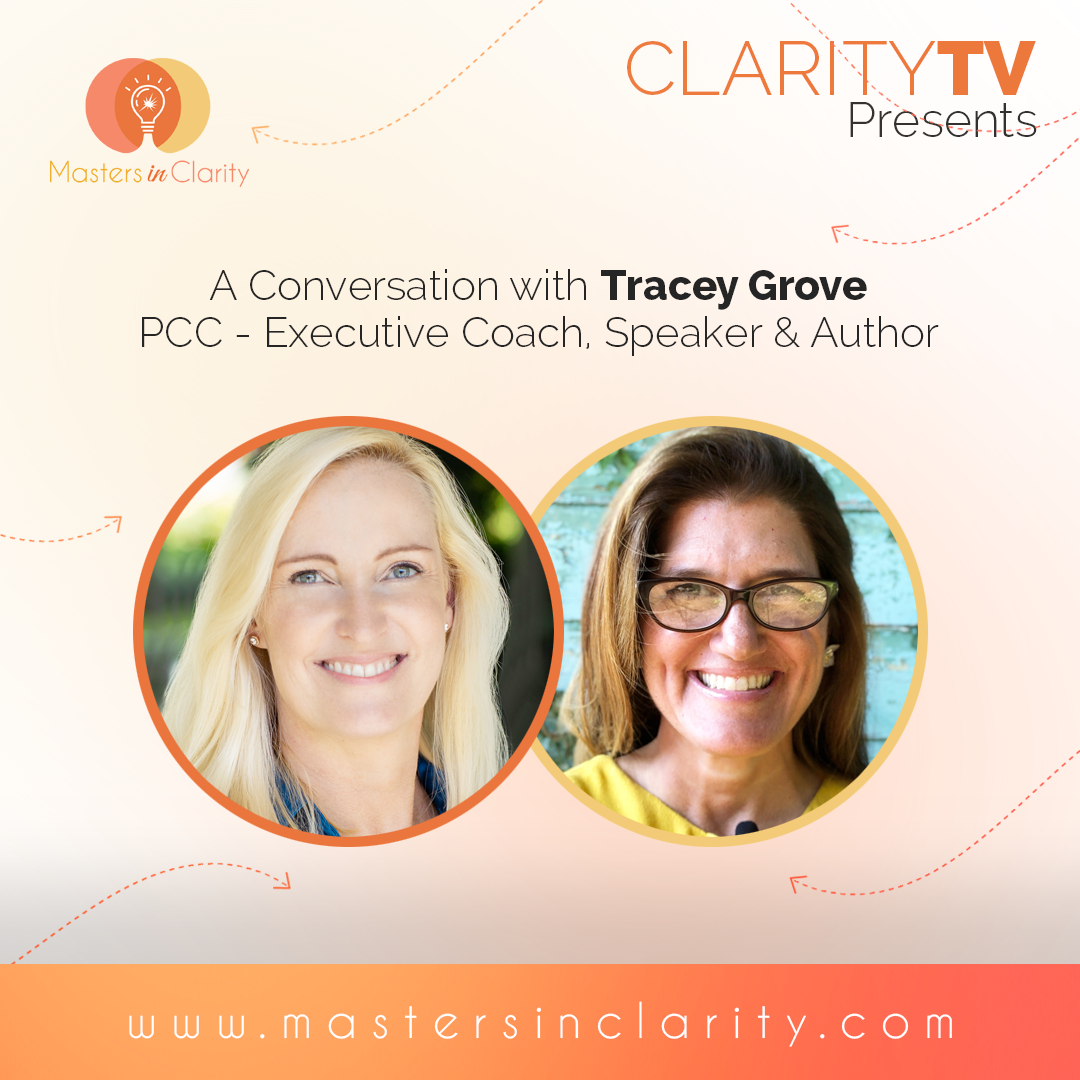
On today’s episode of CLARITY TV, we sat down with Tracey Grove of Pure Symmetry to discuss how people can build resilience, not only in trauma, but in everyday life. Resilience allows us to pause and evaluate a situation and bring our best version forward. Listen to our interview:
After a traumatic experience in her home country of South Africa, Tracey was inspired to help people become resilient. The journey led her to help business leaders help their employees become resilient. Tracey defines being resilient as the ability to anticipate that you will have stressors in your life, but knowing how to navigate the human side of change. It’s a journey, she says, and a practice. By cultivating resilience, you are cultivating courage and the ability to move through fear.
In today’s modern market, leaders need to inspire and motivate their employees.
How do you, as a leader, bring a sense of purpose and belonging to an organization?
Building a platform based on authenticity and humility enables leaders to move forward with the people they lead.
Tracey talks about embracing Epic Failure. By not succeeding, you’re learning!
- What can you do better next time?
- How do you avoid that problem in the future?
- What mistakes did you make the first time around?
It can be a painful process, however, coming together and learning helps you move forward as a better and wiser team.
Resiliency is a muscle and it needs to be used often! How do YOU practice RESILIENCY in your life and in your workplace?
Find more information about being resilient and Tracey herself at https://www.puresymmetry.com/ or pre-order her book “Taming the sabertooth”
In Clarity,

PS: Are you ready to take action? Ready to be seen? Schedule a complimentary call with our CLARITY COACHES and let’s help you create an action plan for you to grow your business by being seen! SCHEDULE A CALL NOW
PS2: If you want to get notified or join us live for a next interview, simply LIKE OUR PAGE

You have your signature talk! Now what? Let me share with you 5 ways to monetize your talk…
Congratulations! You have been featured on some of the most coveted stages in the world. Perhaps it’s a TED, TEDx, 99U, SXSW or other prestigious events, and if you are a professional speaker, this exposure will only propel your career forward.
But what if it’s not propelling your career forward at the rate at which you’d hoped?
What if you are thinking, what other ways can I leverage this exposure in ways that do not require my time or the need to travel?
As a strategist, TEDx organizer, communications coach, and entrepreneur I work with the “before the stage” phase as well as the “after the stage” phase of speaker experience. While reaching some of these stages can feel like climbing a mountain, designing how you will use this opportunity to expand your message, grow your business, and grow your capacity to impact is the most exciting side of this experience.
So, here are 5 ways that you can monetize your talk and examples of people who have done just that:
- Turn your talk into a book proposal and get a publishing contract
- Now, this option is not for everyone, BUT if you have the background and experience to attract this kind of attention then go for it. I have a client who did just that and 12 months after his talk was released he landed a $1.5 million dollar book advance from a prestigious editorial house.
- Turn your talk into a training program
- We all know Brene Brown. Her talk has been watched over millions of times. She started with a TEDx talk and shortly after landed a TED talk as well. It not only propelled her career forward as a speaker and author (she published a few books around her talks), she also launched a full training program where she teaches her methodology around the DARING WAY and certifies professionals. www.thedaringway.com.
- Turn your talk into books
- Brene Brown has done this, but so have Simon Sinek and many other speakers.
- Turn your talk into a coaching program
- Your talk is a about your CORE IDEA and the essence of your work. People who buy into your IDEA want to be guided into bringing this IDEA into their life and work.
- Let your TALK rebrand your company
- Working on your talk (even if you never deliver it) can be a transformative experience. One of my clients experienced just that when she realized that once she delivered her talk, that her company of 16 years had evolved, but her brand was constricting her. The writing and preparation for her talk was the catalyst, not just for a rebrand of the company, but for a whole expansion to new products, services, and markets.
So if you are ready to make this “TALK OF YOUR LIFE” come INTO your life and take over your work, then let’s talk. With my team, this is exactly what we do, and we would love to help you figure out how to build your model. Simply answer a FEW QUESTIONS and book a FREE CLARITY CALL to begin monetizing your talk.
In Clarity,
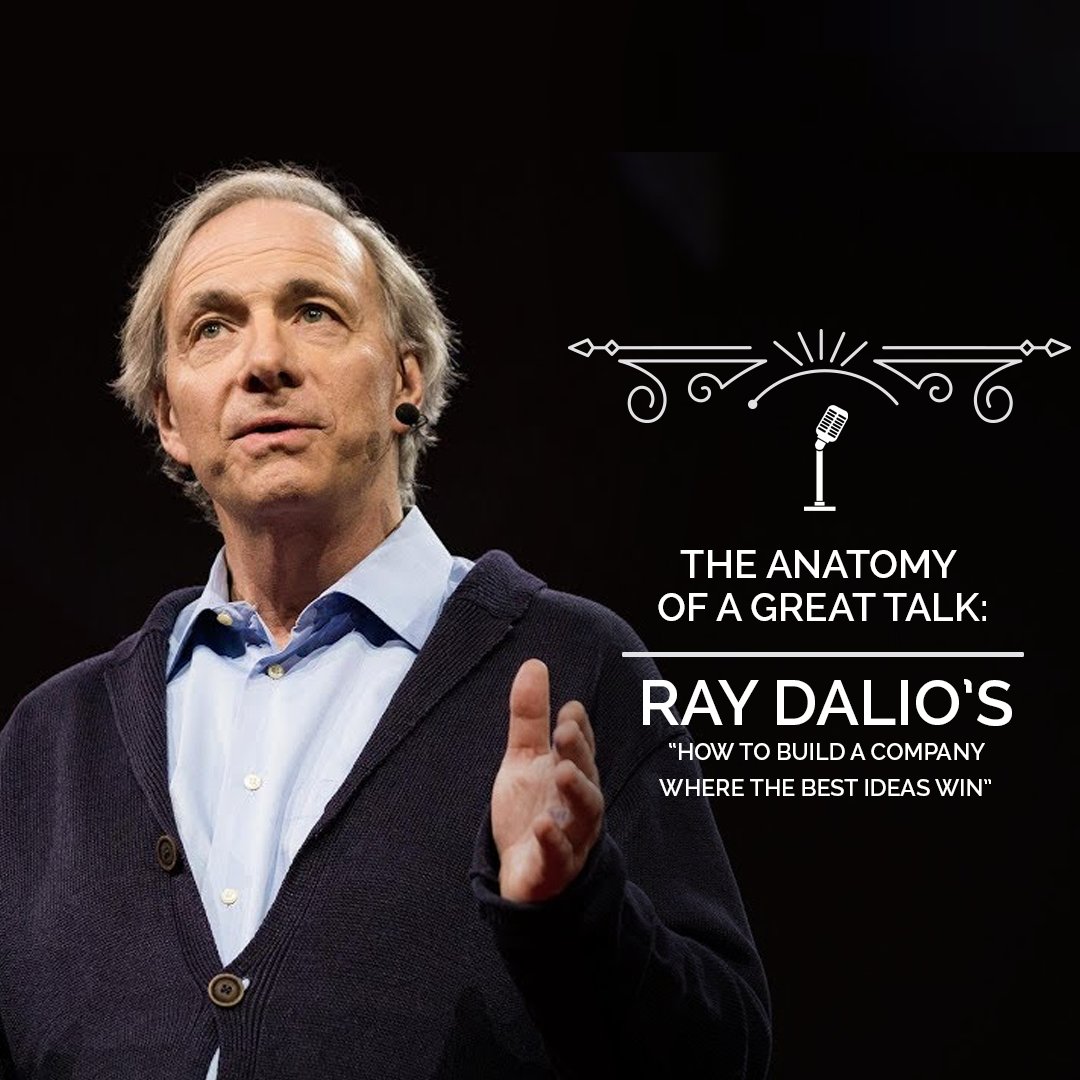
Welcome back to our Anatomy of a TED Talk series!
How do you know if your idea or opinion is RIGHT? Do you utilize collective decision making in your business? Do radical truth and radical transparency really help a work environment?
In this “Anatomy of a TED Talk,” we are exploring Ray Dalio’s talk, who gets raw and shares his painful mistakes and how he turned them into puzzles to produce gems!
Using Masters in Clarity’s proprietary framework for writing an engaging talk, let’s break down Dalio’s talk.
The purpose of the “Anatomy of a TED Talk” series is for you to see our framework in action and begin crafting YOUR engaging signature talk.

Anatomy of a TED Talk:
MAKE YOUR AUDIENCE CARE
00:00
“Whether you like it or not, radical transparency and algorithmic decision-making is coming at you fast, and it’s going to change your life.”
INTRODUCE YOUR IDEA
00:40
“My objective has been to have meaningful work and meaningful relationships with the people I work with, and I’ve learned that I couldn’t have that unless I had that radical transparency and that algorithmic decision-making.”
06:16
INTRODUCE YOURSELF
01:05
“Since I was a kid, I’ve had a terrible rote memory. And I didn’t like following instructions, I was no good at following instructions. But I loved to figure out how things worked for myself. When I was 12,I hated school but I fell in love with trading the markets. I caddied at the time, earned about five dollars a bag. And I took my caddying money, and I put it in the stock market. And that was just because the stock market was hot at the time. And the first company I bought was a company by the name of Northeast Airlines. Northeast Airlines was the only company I heard of that was selling for less than five dollars a share.”
02:16
“ I had to be an entrepreneur and an investor — and what goes along with that is making a lot of painful mistakes. So I made a lot of painful mistakes, and with time, my attitude about those mistakes began to change. I began to think of them as puzzles. That if I could solve the puzzles, they would give me gems. And the puzzles were: What would I do differently in the future so I wouldn’t make that painful mistake? And the gems were principles that I would then write down so I would remember them that would help me in the future. And because I wrote them down so clearly, I could then — eventually discovered — I could then embed them into algorithms.”
4:00
“Eight years after I started Bridgewater, I had my greatest failure, my greatest mistake. It was late 1970s, I was 34 years old, and I had calculated that American banks had lent much more money to emerging countries than those countries were going to be able to pay back and that we would have the greatest debt crisis since the Great Depression. And with it, an economic crisis and a big bear market in stocks. It was a controversial view at the time.People thought it was kind of a crazy point of view. But in August 1982, Mexico defaulted on its debt, and a number of other countries followed. And we had the greatest debt crisis since the Great Depression. And because I had anticipated that, I was asked to testify to Congress and appear on «Wall Street Week,» which was the show of the time.”
05:45
“I was so arrogant, and I was so wrong. I mean, while the debt crisis happened, the stock market and the economy went up rather than going down, and I lost so much money for myself and for my clients that I had to shut down my operation pretty much, I had to let almost everybody go. And these were like extended family, I was heartbroken. And I had lost so much money that I had to borrow 4,000 dollars from my dad to help to pay my family bills.”
06:16
“It was one of the most painful experiences of my life … but it turned out to be one of the greatest experiences of my life because it changed my attitude about decision-making.Rather than thinking, «I’m right,» I started to ask myself, «How do I know I’m right?» I gained a humility that I needed in order to balance my audacity. I wanted to find the smartest people who would disagree with me to try to understand their perspective or to have them stress test my perspective. I wanted to make an idea meritocracy. In other words, not an autocracy in which I would lead and others would follow and not a democracy in which everybody’s points of view were equally valued, but I wanted to have an idea meritocracy in which the best ideas would win out. And in order to do that, I realized that we would need radical truthfulness and radical transparency.”
PRESENT THE EVIDENCE/DATA
07:14
“What I mean by radical truthfulness and radical transparency is people needed to say what they really believed and to see everything. And we literally tape almost all conversations and let everybody see everything, because if we didn’t do that, we couldn’t really have an idea meritocracy. In order to have an idea meritocracy, we have let people speak and say what they want. Just to give you an example,this is an email from Jim Haskel — somebody who works for me — and this was available to everybody in the company. «Ray, you deserve a ‘D-‘ for your performance today in the meeting … you did not prepare at all well because there is no way you could have been that disorganized.» Isn’t that great?”
08:53
“In order to give you a glimmer into what this looks like, I’d like to take you into a meeting and introduce you to a tool of ours called the «Dot Collector» that helps us do this. A week after the US election, our research team held a meeting to discuss what a Trump presidency would mean for the US economy. Naturally, people had different opinions on the matter and how we were approaching the discussion. The «Dot Collector» collects these views. It has a list of a few dozen attributes, so whenever somebody thinks something about another person’s thinking, it’s easy for them to convey their assessment; they simply note the attribute and provide a rating from one to 10. For example, as the meeting began, a researcher named Jen rated me a three — in other words, badly –”
10:40
“This tool helps people both express their opinions and then separate themselves from their opinions to see things from a higher level. When Jen and others shift their attentions from inputting their own opinions to looking down on the whole screen, their perspective changes. They see their own opinions as just one of many and naturally start asking themselves, «How do I know my opinion is right?» That shift in perspective is like going from seeing in one dimension to seeing in multiple dimensions. And it shifts the conversation from arguing over our opinions to figuring out objective criteria for determining which opinions are best.”
REMIND THE AUDIENCE OF YOUR IDEA
08:23
“So for that last 25 years that’s how we’ve been operating. We’ve been operating with this radical transparency and then collecting these principles, largely from making mistakes, and then embedding those principles into algorithms. And then those algorithms provide — we’re following the algorithms in parallel with our thinking. That has been how we’ve run the investment business, and it’s how we also deal with the people management.”
12:46
“Collective decision-making is so much better than individual decision-making if it’s done well. It’s been the secret sauce behind our success. It’s why we’ve made more money for our clients than any other hedge fund in existence and made money 23 out of the last 26 years.”
REVEAL THE NEW REALITY
13:35
“It takes about 18 months typically to find that most people prefer operating this way, with this radical transparency than to be operating in a more opaque environment. There’s not politics, there’s not the brutality of — you know, all of that hidden, behind-the-scenes — there’s an idea meritocracy where people can speak up. And that’s been great. It’s given us more effective work, and it’s given us more effective relationships. But it’s not for everybody. We found something like 25 or 30 percent of the population it’s just not for. And by the way, when I say radical transparency, I’m not saying transparency about everything. I mean, you don’t have to tell somebody that their bald spot is growing or their baby’s ugly.”
INVITE YOUR AUDIENCE TO TAKE ACTION
15:28
“So when you leave this room, I’d like you to observe yourself in conversations with others. Imagine if you knew what they were really thinking, and imagine if you knew what they were really like … and imagine if they knew what you were really thinking and what were really like. It would certainly clear things up a lot and make your operations together more effective. I think it will improve your relationships.”
I want to encourage you to take our framework, and testing against talks you’ve done i the past. What could you tweak to further the engagement with your audience? Check out more in our “Anatomy of a TED Talk” series!
Also…
We’d love to invite you to attend our upcoming Live Clarity Event!
FEBRUARY 27th, 28th 2019
WORKSHOP TOPIC: BUSINESS MODEL & PROPRIETARY SYSTEM
Click HERE for more info and to reserve your spot!
In Clarity,

Dolores Signature in green

How do you get your BRAVE on? How do you make the decision to be brave?
In this episode of Clarity TV, Jena Rodriguez of BraveMasters challenges us to push ourselves to take action and stop staying comfortable in inaction. She is on a committed mission to eradicate unrealized human potential! Jena gives tips on how to build relationships, a strategy to help you get past the “I don’t know how” syndrome and find your Brave!
She invites us to Think it – Declare it – Commit to It!
During our interview, Jena and I talked about a whole lot of things, but one of them is the concept of being a “VICTIM”. Are you a victim of circumstances and feel stuck? Jena recommends these tips to help you get UNstuck:
- Live more consciously aware
- Be willing to be uncomfortable
- Be willing to make tough choices, even in the hardest moments
Entrepreneurship is an example of full potential — you can decide what you’re worth, how you serve, and how you help!
In 2012, Jena left her storefront business and went into business with her husband. In 2013, she decided to go bigger and be a speaker. She made a decision to be brave and stop holding herself back. She began by committing and then taking action. By speaking in public, she increased her income by 65% in that first year. Being visible brought her amazing results!
So go ahead, Think it – Declare it – Commit to It!
…and don’t forget, to be BRAVE 🙂
PS: Are you ready to take action? Ready to be seen? Schedule a complimentary call with our CLARITY COACHES and let’s help you create an action plan for you to grow your business by being seen! SCHEDULE A CALL NOW
PS2:If you want to get notified or join us live for a next interview, simply LIKE OUR PAGE
PS3: Want to be a guest in our show? Apply Now…